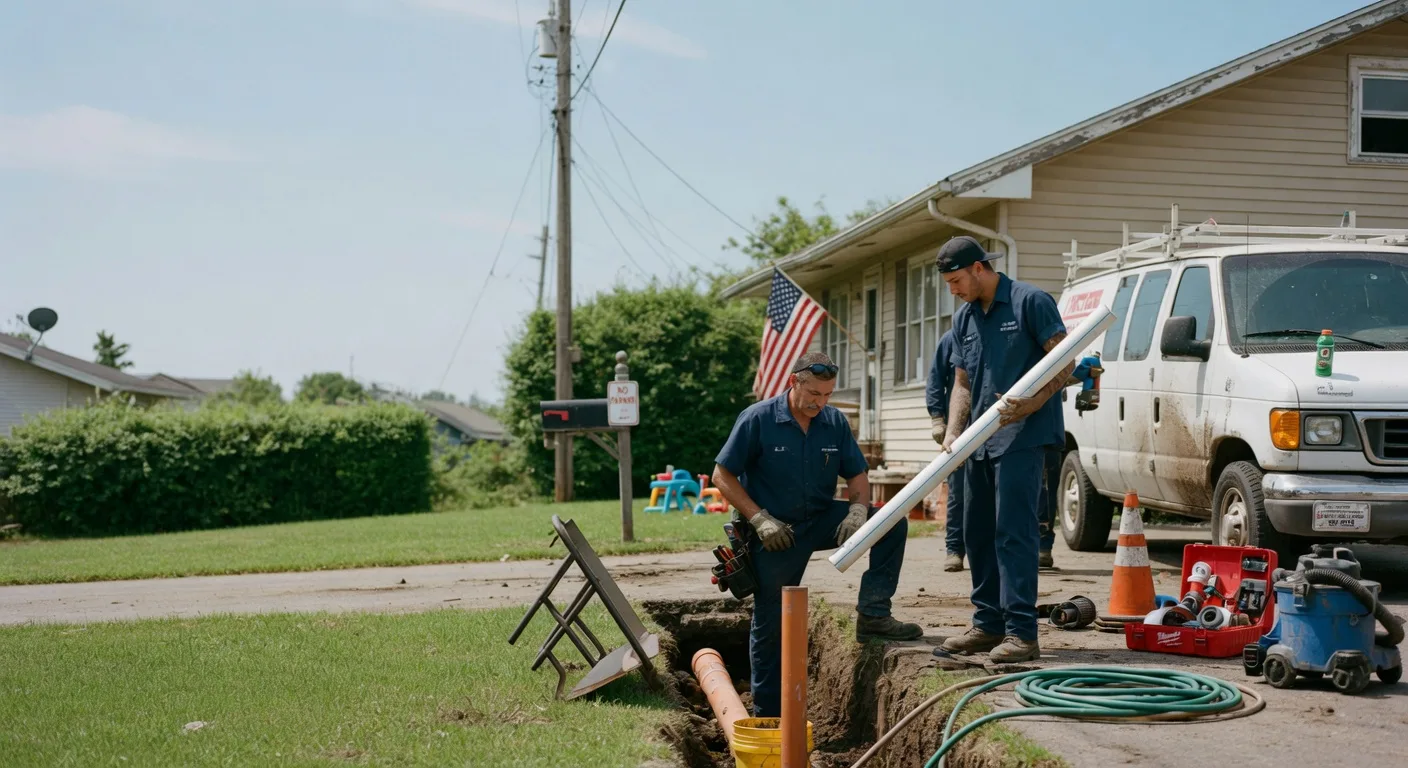
When is a drain backup a plumbing emergency?
Stop running water and call now if water is backing up from more than one drain, sewage is coming up through a floor drain or tub, a toilet overflows on its own, or you smell sewer gas inside the house. Those signs point to a blocked or failed main line. That is a different problem from one slow sink. The main line carries everything the house sends out, so when it stops, water has only one place to go, which is back up through the lowest opening in the house, usually a basement floor drain or a tub. Every load of laundry, dishwasher cycle, or shower adds to the flood, so turning off water use is the most useful thing you can do while you wait. Do not try to clear a full main line yourself; it takes a larger cable or a jetter, and sewage carries bacteria. Keep children and pets out of the affected area. A single slow drain that still empties, or a fixture that gurgles once in a while, can usually wait for a scheduled visit. A backup that is rising, spreading, or coming from several places cannot. Call (380) 262-9173 to be connected with an independent plumber in Rowe, VA.
If you decide the situation is serious, a few quick actions will limit the damage. Shut off the washing machine and dishwasher, and ask everyone to hold off on flushing. If water is already on the floor, lift rugs and move belongings out of the way, and keep electrical items and cords clear of wet areas. Do not run a wet vacuum on sewage, and do not wade through it barefoot. Take photos of the water and the affected fixtures, since they help if you later need to describe the problem to an insurer. Open a window for ventilation if the smell is strong. Know where your main water shutoff is, because if a supply line is leaking rather than a drain backing up, that valve is the right one to close. Older homes often have a floor drain that is the first place sewage appears, so check it first.
What should I clear out or get ready before the plumber arrives to unclog my drain?
A little preparation saves time at the door and often means a cleaner, faster job. Most of it takes ten minutes.
Start with access. If the clog is in a sink, empty the cabinet underneath. Plumbers need to reach the trap and the wall pipe, and stored cleaning products tend to be in the way. Put a bucket and some old towels nearby. If the problem is a tub or shower, remove the rugs and anything sitting on the edge.
If the problem might be in the main line, find the cleanout. It is a capped pipe, often three or four inches across, in a basement, a crawlspace, a garage wall, or outside near the house. Clear a path to it. Move boxes, shelves and stored items, and trim back any plants hiding an outside one. If you cannot find it, tell the plumber. Do not try to unscrew an old cap with a hammer.
Pets matter more than people expect. A cable machine is loud, doors will be open, and an anxious dog or a cat slipping into a crawlspace is a real problem. Put animals in a closed room or a different part of the house.
Next, write a short list of which fixtures are affected. For example: the kitchen sink is slow, the downstairs shower gurgles, the toilet is fine. Add when it started and whether it happens only when the washer runs or when it rains. That list tells the plumber whether to look at a branch line or the main line before anyone touches a tool.
Also stop doing a few things. Do not pour chemical drain cleaner in before the visit, since it can burn skin and make the pipe unsafe to work on. If you did already, tell the plumber what you used.
Finally, if water is coming up through a floor drain or toilet right now, stop running water in the house and keep children and pets away from it. Call straight away rather than waiting to tidy up.
Cost depends on access, so a clear path to the pipe can help keep the visit short.
If you need a drain cleared in Rowe, VA, Expert Plumbers Co can connect you with an independent local plumber at (380) 262-9173.
The plumber cleared my line but said the pipe itself has a problem. How do I make sense of the options he lays out?
It is a letdown to pay for a cleared drain and then hear that the pipe is the real trouble. It is also useful information, as long as you understand what you are being offered.
Start by asking what the problem actually is. Common answers include roots entering a clay joint, a bellied section that holds water, a cracked or collapsed pipe, heavy scale in cast iron, or a joint that has pulled apart. Each one has a different fix, and each one has a different level of urgency.
Ask how the plumber knows. The strongest answer is a camera inspection you can watch. If the opinion came from the feel of the cable alone, a camera look is a fair thing to request before spending a lot of money.
Then ask for the options in a clear order, from least to most work.
Keep clearing it on a schedule. This suits roots or grease when the pipe is otherwise sound. It does not fix the pipe, so ask how often it would likely be needed.
Spot repair. A short section is cut out and replaced. This suits one crack or one bad joint, and depends on how deep it is and what has to be dug up.
Trenchless lining or pipe bursting. A new liner or pipe is pulled through the old one with less digging. It depends on the pipe's condition and the line layout.
Full replacement. The failed line is dug up and replaced. This is the most disruptive choice and usually the last resort.
For each, ask what happens if you wait. A small root problem may give you months. A collapse usually does not.
Cost depends on how deep the pipe is, how much has to be opened up, what is above it, such as a driveway or a slab, the materials, and permits under local code. Ask the plumber to put the scope in writing so another plumber can price the same job.
You are allowed to take time and get a second opinion, especially if the pipe is not backing up today.
If you need a drain cleared in Rowe, VA, Expert Plumbers Co can connect you with an independent local plumber at (380) 262-9173.
We are buying a house. Is a sewer camera inspection before closing worth it, and what does it find in older homes?
A standard home inspection covers what can be seen and reached. It does not follow the main drain out under the yard, and that buried pipe is where the expensive surprises sit. On an older house, a camera inspection of the sewer line before closing is usually worth doing.
A plumber feeds a small waterproof camera down the line, normally through a cleanout, and watches the pipe on a screen. The run goes from the house toward the street connection, and the plumber notes how far along each problem sits.
Here is what tends to turn up in older homes:
Tree roots in clay or concrete pipe, entering at joints. They look like fine hair or a thick mat.
Cast iron that has scaled up inside, narrowing the bore, or has cracked along the bottom.
Fiber pipe made of tar and wood pulp, which can go oval and collapse over time.
A bellied section, where the pipe has sagged and holds a pool of water.
Offset or separated joints where the soil has moved, and old broken sections from past digging.
Ask for the video or screenshots, and for the distance of each defect from the cleanout. That gives you something concrete to show your agent and the seller. A root problem that a cable machine or hydro jetting can clear is a very different matter from a collapsed section that needs digging or a trenchless liner. What a repair costs depends on depth, access, how much yard, driveway or slab has to be opened, the materials, and local permit rules. Those are the things to ask a plumber about once the footage is in hand.
Two practical points. First, find out whether the cleanout is reachable, and tell the seller you need access during your inspection window. Second, a camera cannot see through a line that is full of water or packed solid, so the plumber may need to clear it first. If the seller says the line has never given trouble, that is useful, but it does not show the condition of the pipe.
Ask also whether the lateral is shared with a neighbor, since that changes who deals with a defect.
Expert Plumbers Co can connect you with an independent plumber in Rowe, VA for this: call (380) 262-9173.
The outdoor drain by my driveway, patio or basement stairwell floods in heavy rain. Who clears that?
"The drain by my driveway floods every time it rains hard." Outdoor drains at driveways, patios and basement stairwells fail in heavy rain because they are built to move a lot of water quickly, and leaves, silt and gravel stop that. The grate clogs, then the pipe below fills.
The first thing to know is where it goes. Many exterior area drains tie into a storm line or a dry well, not the sanitary sewer. Some connect to the house drain, and rules vary by area on whether that is allowed. Where the pipe ends decides who can service it, what tools make sense and whether a permit is involved.
Common causes are packed leaves and silt in the drain body, a pipe crushed or shifted by a root or vehicle, tree roots entering a joint, a pipe with too little fall so it holds water, and a storm line that is full or backed up downstream. In a stairwell, the pipe often runs to a lower point and can clog with mud.
If one outdoor drain floods and the rest of the house drains normally, the blockage is in that outdoor branch. If basement floor drains and toilets back up in the same storm, the drain may be tied to the house drain or the main line is overloaded. Check which, because that changes the repair.
Safe homeowner check: Take the grate off and clear leaves and debris by hand with gloves. Look into the drain with a light. Pour a bucket of water in and watch if it drains or stands. Note whether the problem happens only in heavy rain. Do not stand in standing water near electric outlets, and do not poke the pipe with a rod that could crack it.
Stop running water and call now if water is entering the house through a door or foundation, a basement drain is rising, sewage smell comes with the flooding, or the water backs up into indoor fixtures.
A cable machine can clear soft debris and some roots. Hydro jetting is better for packed silt and fine roots in a longer run. A camera inspection helps when the drain keeps flooding, because it shows a collapsed section, a belly holding water, or where the line actually discharges.
Expert Plumbers Co is a referral service. We connect you with an independent local plumber in Rowe, VA. Call (380) 262-9173.
Ask the plumber where the drain discharges and whether it can be reached with a cleanout. Ask whether a repair or regrading is needed, not just clearing. Cost depends on access, the parts or materials needed, how much of the paving or soil has to be opened up or removed, and any permit or code requirement.